

AI in Healthcare
Artificial intelligence, applied with care
Artificial intelligence can help healthcare organisations understand data, support decisions and reduce administrative burden, but only when it is applied to a well-defined problem, validated rigorously and governed responsibly. We help institutions identify where AI can add real value and how to adopt it safely.
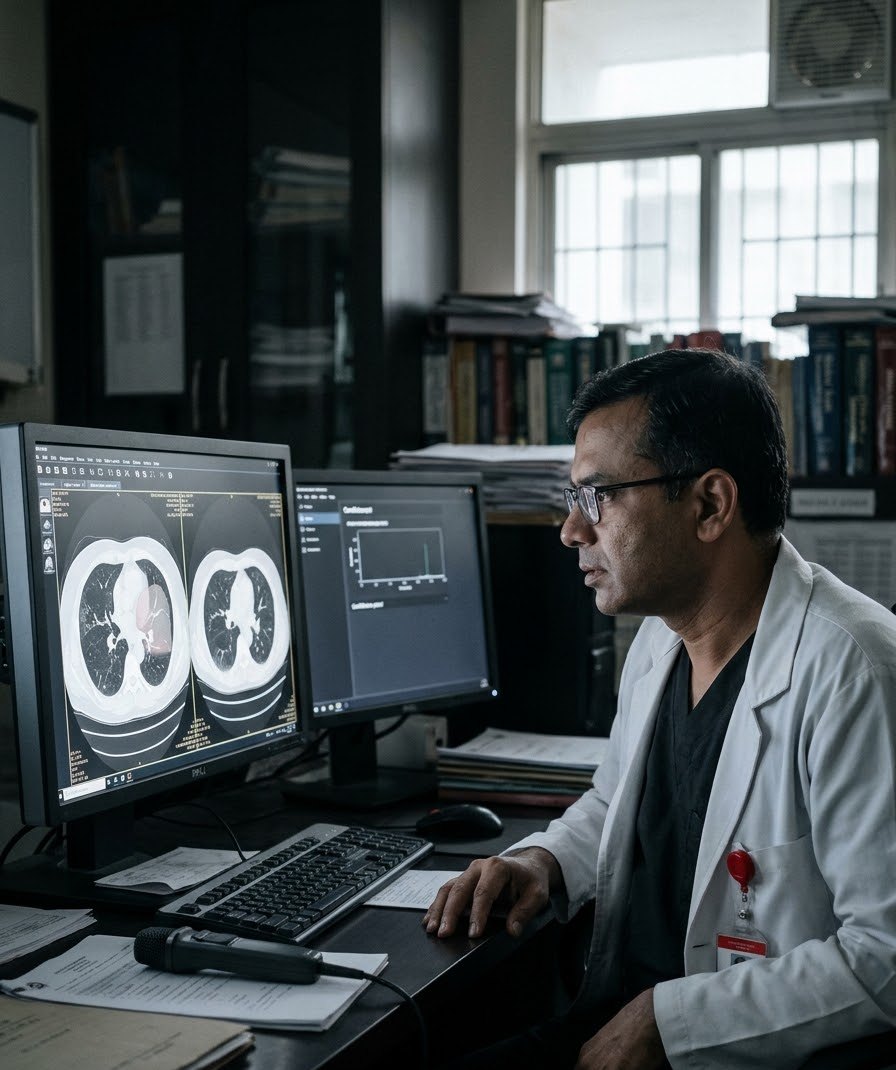 Fig. 06 — AI in Healthcare
Our AI in Healthcare service combines data science, clinical understanding and governance expertise. We focus on practical use cases, honest evaluation of what AI can and cannot do, and keeping clinicians and educators in control of decisions that matter.
Hospital executives and clinical leaders, chief information and data officers, medical educators, researchers, and healthcare start-ups developing AI-enabled products.
Challenges we address
- 01Unclear which problems are genuinely suited to AI
- 02Data that is incomplete, siloed or not ready for modelling
- 03Concern about bias, transparency, safety and accountability
- 04Difficulty validating AI tools against local clinical reality
- 05Integrating AI outputs into clinical and educational workflows
- 06Evolving regulatory and ethical expectations
Services we offer
AI readiness and use-case assessment
Reviewing data, systems and priorities to identify realistic, valuable use cases.
Data preparation
Structuring, cleaning and governing data so that it is fit for analysis and modelling.
Model development and evaluation
Building and testing predictive and analytical models, with clear performance reporting.
Pilot design and validation
Controlled pilots with defined measures, clinical oversight and review points.
Workflow integration
Embedding outputs in clinical, administrative and educational workflows.
AI governance and ethics
Policies for transparency, bias monitoring, privacy, human oversight and accountability.
Education and AI literacy
Briefings and training so clinicians, educators and leaders can use AI confidently.
Curricula development and training
Designing AI and digital health curricula, learning outcomes and assessment for medical, nursing and allied health programmes, and delivering the training that equips faculty, clinicians and students to put them into practice.
Our commitments
AI supports professional judgement; it does not replace it. We build in human oversight, test for bias and performance on relevant populations, protect patient data and document how models work and where they should not be used.
Healthcare Informatics